
The scientific activities were devoted to providi marine ecologists with an innovative workflow based on a novel multi-sensor measuring system and a tool for automatic extraction of relevant biometric macro-descriptors. The workflow was validated in laboratory-controlled conditions; tests in open water were also carried out to evaluate performances and open challenges.
The EUPHROSYNE work packages organization, with enhancement of the involved expertise and cross-disciplinary cooperation, is reported below.
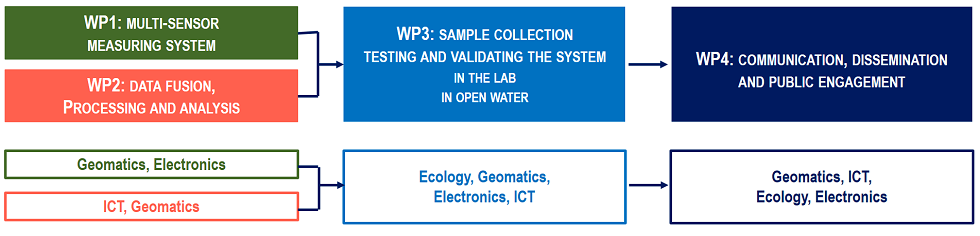
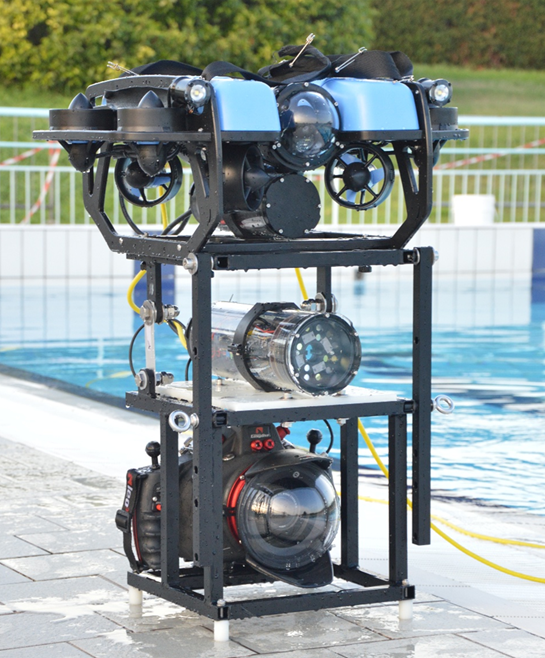
The prototype of the multi-sensor measuring system, integrating photogrammetry and fluorimetry, for studying mediterranean corals at fine scale and high resolution. The prototype is working on board of the BluROV2 of BlueRobotics but the installation could be modified in case of other ROVs. The manual use is also possible with some limitations. The system itself was developed and tested in dry environment; tests in laborstory were also used to deeply analyze and validate the resulting products as well as to identify their usefulness in ecological applications. The proper functioning of the system on board of the ROV was tested in controlled water conditions (swimming pool) before performing the test in open water.
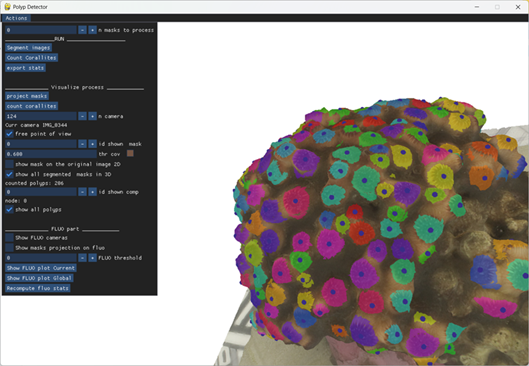
the development of a tool, named Polypstats, capable of fusing data form photogrammetry and fluorimetry, of combining high resolution of original 2D images with geometry content and common alignment of 3D models, with the overall aim of processing datasets through algorithms of artificial intelligence. Polypstats is an algorithm developed for counting and measuring corallites in Cladocora caespitosa colonies; it is integrated into an interactive Graphical User Interface (GUI) designed to support ecological research. Besides supporting the automatic identification and counting of corallites, the tool provides quantitative extraction of further biometric metrics. For each corallite, the surface area of the oral disc, along with its length (measured by the maximum axis of the oral disc) and width (measured by the minimum axis of the oral disc) are determined. Additionally, the average RGB color and the average fluorescence intensity are calculated for each corallite.
Tests were performed on live colonies of Cladocora caespitosa as a model. This endemic zooxanthellate coral is the most important reef-building species in the Mediterranean and it is included in the Red List of the International Union for the Conservation of Nature (IUCN) as an endangered species. Fragments of naturally detached and healthy colonies of Cladocora caespitosa (with colored polyps and no signs of necrosis or bleaching, among those naturally detached from the substrate after sea storms) were collected at Santa Maria al Bagno (Nardò, Italy) in autumn 2023. Coral samples are shown below.

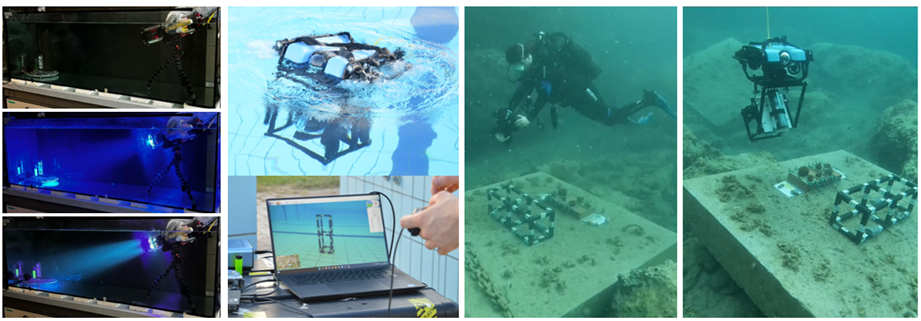
The integrated measuring system, as well as the capability of the Polypstats tool, were tested within a recirculating seawater aquarium system with multiple tanks and controlled laboratory conditions. Then the manoeuvering, the balance and the operation onboard of the ROV were proved in a swimming pool. Finally, open water tests (with both scuba divers and ROV) under natural conditions were carried out: dives at different hours of the day helped understanding the impact of varying light conditions; different current and turbidity were also faced. Below pictures about these tests. In particular, the picture about laboraotry tests show the device for measuring the flourescence with modification of illuminants (LED off, active blue LED, active violet LED). Open water tests were carried out in Puglia, thanks to the support and the hospitality of Nardò Municipality. The swimming pool for testing onboard of the ROV were allowed by the great contribution of UISP Reggio Emilia.