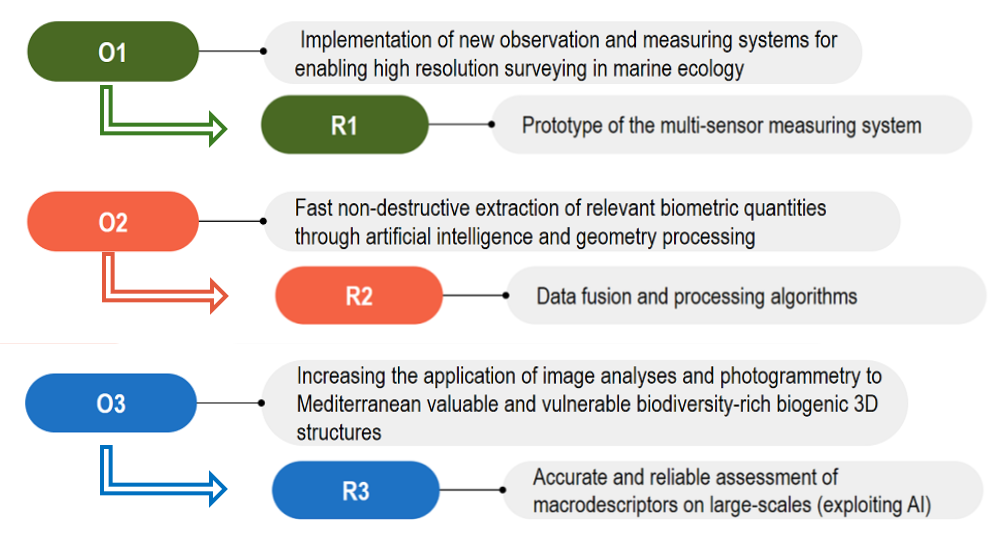

The EUPHROSYNE research project focused on improving and testing both in the laboratory and in the open water a multi-sensor measuring system based on the integration of photogrammetry and fluorescence imagery. EUPHROSYNE also experienced the benefits of using SCUBA divers and underwater remotely operated vehicles (UROVs) for data capturing. Combining these emerging techniques (that can be applied to a range of 3D morphometrics, different habitats, and species) paves the way to innovative opportunities in ecological research and more effective results than traditional in-situ measurements. International guidelines, indeed, pursue the importance of preserving benthic environments, where a wide number of habitat-forming species is currently threatened by both anthropogenic pressures and biogeochemical disturbances. Within this context, the role of monitoring is crucial, providing essential information for mapping the ecological status of underwater environments and quantifying the impact of global changes on marine species. Detecting the health status of endangered marine species demands a high degree of accuracy and fine-scale resolution and this requires processing an increasing amount of data; analyzing such data is hard to sustain without automation. The development of AI (artificial intelligence), computer vision and geometry processing algorithms for automating data analysis allowed the fast non-destructive extraction of relevant biometric quantities from benthic communities and provided ecologists with a methodology for automated measuring of coral digital twins (polyps count, surface areas or volumes) and for supporting the assessment of species health status at a fine scale using fluorescence. Therefore, EUPHROSYNE implements the full process, a whole workflow from data capturing, based on the developed multi-sensor measuring system, to data processing and analyzing. Testing and validating were performed on Mediterranean habitat-forming anthozoans of international conservation interest, sensitive to climate alterations and threatened by anthropogenic pressures acting at local scales (e.g. pollution, recreational SCUBA diving, fishing gears, and boating). Thus, this project contributed to the development and empowering of innovative procedures, algorithms and methods to improve underwater survey techniques and detect changes in biological systems, fostering the targets of the European Green Deal and EU Biodiversity strategy.

The EUPHROSYNE project was intended to focus on three main objectives leading to three corresponding final outcomes.